





















What is CRM? What is ERP? Brief Definitions
CRM is a system that enables a business to manage customer communication, sales opportunities, and support processes from a single center (details: What is CRM? ). ERP, on the other hand, is a system that integrates internal business processes such as finance, inventory, production, and human resources into a single database. Both are data-driven, but they focus on different aspects: CRM focuses on the customer, while ERP focuses on operations.
What is the main difference between CRM and ERP?
|
Criterion |
CRM |
ERP |
|
Focus |
Customer relations and sales |
Internal business processes and operations |
|
Orientation |
Outgoing (customer, market) |
Introverted (finance, inventory, production, HR) |
|
Typical user |
Sales, marketing, support teams |
Finance, operations, production, HR teams |
|
Basic data |
Customer profile, opportunity, contact history |
Inventory, order, cost, payroll, production data |
|
Typical output |
Sales funnel report, customer satisfaction |
Financial report, inventory status, production plan |
Although this table draws a clear line, in daily life the two are intertwined: a sale is closed in the CRM, but invoicing and inventory reduction take place in the ERP. Therefore, for most growing businesses, the real question is not 'CRM or ERP?', but 'how well do the two work together?'
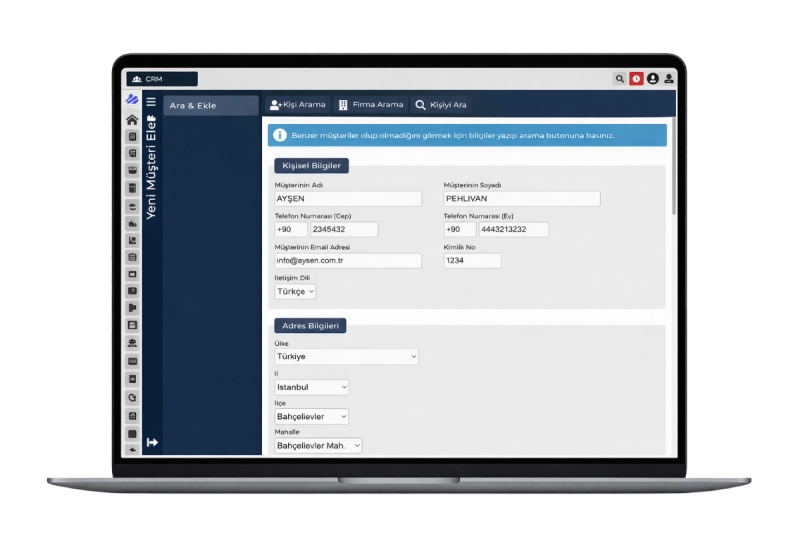
Why is neither CRM alone nor ERP alone sufficient?
-
In a business that only uses CRM, sales are closed, but invoicing, inventory, and accounting are processed manually in separate systems; data is entered twice, increasing the risk of errors.
-
In a business that only uses an ERP system, operations are streamlined, but the sales team lacks skills in opportunity tracking, customer history, and marketing engagement.
-
If the two systems are not integrated, management is forced to make decisions not from a single reliable source, but from two conflicting reports.
-
Real value arises from CRM and ERP working together on the same platform, sharing the same database — which is the foundation of Entranet's platform approach.
Which Business Needs Which?
If the sales/customer relationship process is complex and there is no inventory/production operation (e.g., a small business selling services), CRM alone may suffice. If there is inventory, production, or a multi-departmental finance process, ERP is essential. If both are needed—which is the case for most growing businesses—integrating CRM and ERP on the same platform leads to fewer errors and faster decision-making than managing two separate systems.
Example Scenario: From Separate Systems to an Integrated Platform
A business that tracks its sales in one CRM system and its accounting in a separate program had to manually re-enter invoices into the second system when a sale was closed. After starting to use CRM and ERP integrated on a single platform, the transition from sales to invoicing became automatic, and duplicate data entry was eliminated.
Frequently Asked Questions
Do I need to use CRM and ERP simultaneously?
No, it depends on your needs; however, if you have inventory/production/finance processes, integrating the two is recommended for data consistency.
How can CRM and ERP data be integrated?
When they operate on the same platform, they share a common database; when a sale is closed in the CRM, the relevant invoice and inventory movement are automatically generated on the ERP side.
When does a small business need an ERP system?
When inventory tracking, production planning, or multi-departmental finance processes can no longer be managed with Excel/manual methods, it's time to switch to an ERP system.
Are CRM and ERP separate products on an intranet?
No; on an Entranet platform, CRM and ERP applications share the same database and work together.
Ready to use CRM and ERP together on a single platform? Try Entranet for free .
Related pages: What is CRM? Customer Relationship Management Guide · Sales Solution · Finance & Accounting Solution