

























What are the challenges faced by medium-sized businesses when choosing an ERP system?
Medium-sized businesses have to manage processes as complex as those of large corporations, without having the same large budgets. This dilemma highlights eight key challenges in ERP selection.
|
Difficulty |
Why is it critical? |
|
Correctly defining the scope |
If it is not clearly defined which processes (sales, inventory, finance, HR) will be migrated to the ERP system, either the project will start with insufficient scope or budget will be spent on modules that will not be used. |
|
Flexibility |
The processes of a medium-sized business change frequently during growth; a closed/fixed-structure ERP will require re-customization after a few months. |
|
Cost control |
If the total cost, including licensing, installation, and training, isn't clarified upfront, the budget may be exhausted before use. |
|
Modern technology and scalability |
In growth steps such as opening new branches, adding field teams, or switching to hybrid operations, outdated infrastructure creates bottlenecks. |
|
Strong support ecosystem |
If post-installation support is discontinued, there will be no one left to reflect process changes in the system, and usage will decrease over time. |
|
Third-party integration capability |
ERP systems that cannot connect with external systems such as e-invoicing, e-commerce, or banking, double the amount of data entry instead of reducing it. |
|
User experience |
A complex interface delays employees from integrating the system into their daily work; if adoption remains low, the investment will not pay off. |
|
Security and compliance |
If authorization and access control are weak, the risk of data access problems increases as the team grows. |
Why is a comprehensive and integrated ERP structure essential?
When departments operate with separate systems, the same customer or product information is stored differently in multiple locations; for example, the stock quantity seen by the sales team may not match the quantity seen by the warehouse team. In a comprehensive and integrated ERP structure, this data is fed from a single source (sales, inventory, finance, HR on the same platform); updates in one department are automatically reflected in others, eliminating the need for manual information transfer between departments.
Why are flexibility and adaptability important?
A medium-sized business might be operating with a single branch this year, but could expand to three branches and a field sales team next year. In a modular ERP structure, the required application (e.g., field sales module) is added to the existing setup; the entire system is not reinstalled. Intranet-based design works on the same principle: a new process or approval workflow can be implemented while preserving the existing user authorization and interface structure.
How to Achieve a Balance Between Cost and Efficiency?
"The most expensive ERP is the one that isn't used" — meaning the real cost risk isn't the high price of the licenses, but the fact that the purchased modules aren't used. Here are three practical suggestions to strike this balance:
-
Opt for module-based pricing: you only pay for actively used applications, and unused licenses don't waste your budget.
-
Monitor the usage rate after installation: if a module is still underutilized after a few months, it needs to be clarified whether the training or the module itself is the problem.
-
Consider scaling costs from the outset: the additional cost of adding new branches or users should be as decisive in the decision-making process as the initial setup price.
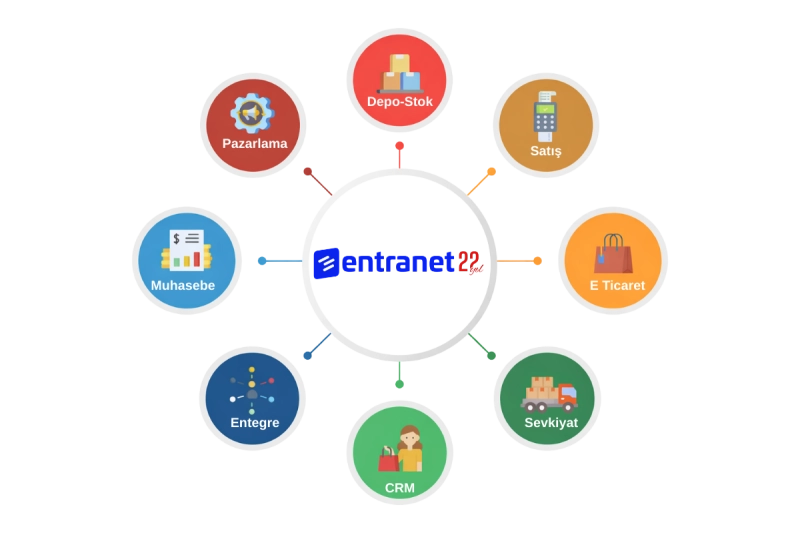
Entranet Approach: Support, Integration, and User Adoption
Entranet is a 22-year-old software platform with an application-based architecture that enables businesses to manage all their business processes on a single platform with over 300 applications. It runs on industry-specific products such as Aidango, Titarus, Trizbi, Comwize, Flaterp, Penamo, and Korivus.
This architecture addresses all three challenges: post-installation support continues as the business grows and new applications are added to the existing structure (no reinstallation is required); third-party integration can be done without changing a single module thanks to the application-based structure; and user adoption is accelerated as processes appear within the intranet interface, on screens that employees are already using — for example, a permission approval or purchase request is completed on the same intranet panel without switching to a separate ERP screen.
Frequently Asked Questions
What is the biggest risk when choosing an ERP system for medium-sized businesses?
Incorrectly defining the scope: allocating budget to unnecessary modules or excluding truly necessary processes negatively impacts both cost and utilization rate.
What does a modular ERP structure provide?
As the business grows (with new branches, field teams, hybrid operations, etc.), only the necessary applications are added to the existing setup; the entire system is not reinstalled.
What does "The most expensive ERP is the one that isn't used" mean?
This means the real cost risk isn't the license price, but the low utilization rate of the purchased modules; decisions made without monitoring usage rates will lead to inefficient budget expenditure.
Why is user adoption so crucial to ERP success?
No matter how comprehensive a system is, the investment won't pay off if employees don't use it in their daily work; presenting processes in a familiar interface (e.g., intranet dashboard) accelerates adoption.
The right ERP solution for a medium-sized business is not about individual features, but about an integrated approach that accurately defines its scope, operates flexibly and seamlessly, balances cost with usage rate, and provides post-installation support. You can take advantage of a free trial to evaluate Entranet's application-based architecture.