
























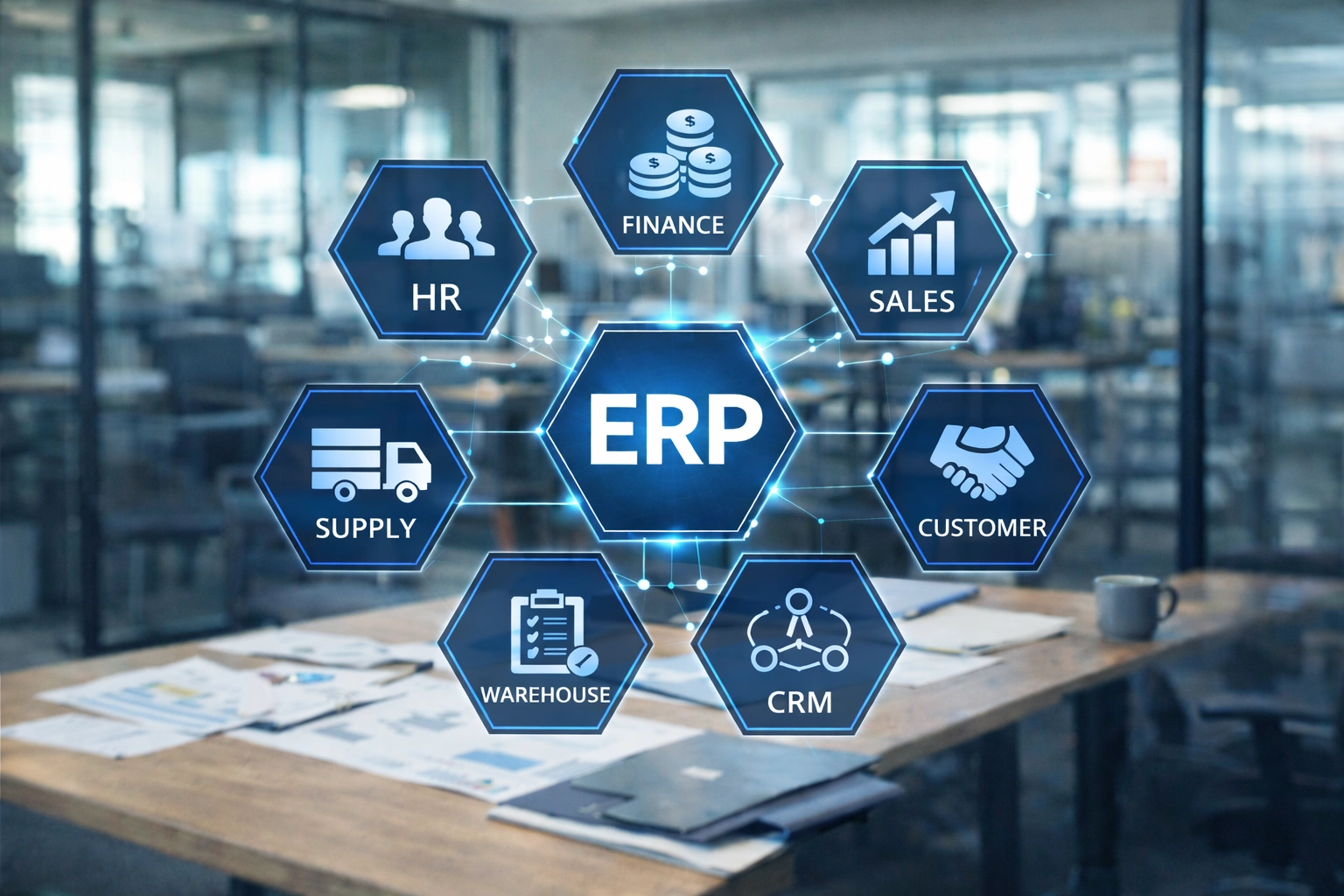
What is Industry-Specific ERP, and How Does it Differ from General ERP?
Industry-specific (sector-specific) ERP systems embed a sector's standard workflows, terminology, and regulatory requirements—requiring no definition from scratch during installation. General ERP, on the other hand, is sector-independent, comes with basic finance/inventory/sales modules, and is customized to the company's own processes. The value of an ERP largely depends on how well it understands the sector: a manufacturing company and a logistics company have fundamentally different expectations from an ERP system.
How does a sector-specific ERP approach work?
-
Industry standard processes (e.g., capacity planning in production, shipment planning in logistics) come as ready-made templates in the system.
-
Industry-specific reporting and terminology are reflected in the interface in a way that is familiar to the user.
-
Legislative and sectoral integration needs (e.g., e-invoicing, sectoral notifications) are considered in advance.
-
The company can still make further customizations for its specific processes; the industry structure is a starting point, not a limitation.
What are the benefits of a sector-specific ERP system?
-
Shorter setup time: no customization is required from scratch as industry standard processes are already in place.
-
Lower customization costs: instead of adapting a generic ERP to a specific industry, the system is fine-tuned to suit the industry's needs.
-
Sector-specific reporting: management finds readily available metrics that are relevant to their specific industry (e.g., OEE in manufacturing, shipping performance in logistics).
-
Lower implementation risk: there are fewer 'unknowns' because it is built on a structure that has been tried and tested in the sector.
Which approach is suitable for which sector?
|
Sector |
Key ERP Needs |
The Contribution of a Sectoral Approach |
|
Production |
Production planning, capacity management, cost tracking. |
Capacity and cost calculations are readily available using sector-specific formulas. |
|
Retail and E-commerce |
Multichannel sales, inventory accuracy, demand forecasting. |
Cross-channel stock synchronization has been redesigned from the ground up. |
|
Service |
Project management, resource planning, time-based billing. |
Hourly/project-based billing logic comes with a ready-made template. |
|
Logistics and Supply Chain |
Warehouse operations, shipment planning, supply chain optimization. |
Shipping and warehousing processes are established according to industry standards. |
To see if there's an Entranet product specifically designed for your industry, you can refer to the "Which ERP/Software Should I Choose? Product Selection Guide" article.

Frequently Asked Questions
Is industry-specific ERP always better than general ERP?
No, it depends on the company's needs. Businesses with industry-specific, complex processes benefit more from an industry-specific approach; businesses with a wide variety of activities may prefer the flexibility of a general ERP system.
Is it possible to switch to a sector-specific ERP system later on?
Yes; many businesses start with a general structure and add industry-specific modules to the system as they grow.
What if there isn't a dedicated Entranet product for my industry?
Flaterp, offering a general/industry-specific cloud ERP infrastructure, is a flexible starting point for businesses that don't have a dedicated product to replace it.
Would sector-specific ERP implementation be faster?
Generally yes; the need to define things from scratch is reduced because the industry's standard processes are already in the system.
Ready to discover the approach that best suits your industry? Try the Entranet product family for free .
Related pages: All Entranet Products · The Era of Artificial Intelligence in ERP · Production Solutions · Inventory and Purchasing Solutions