























In many businesses, employee performance monitoring is still based on end-of-period reviews and the manager's general opinion. However, in companies aiming for sustainable growth, the performance evaluation process must be based on measurable data. An incomplete picture emerges when factors such as the rate of achievement of goals, the quality of work output, time management, and adherence to processes are not evaluated together.
ERP system and personnel performance tracking clarify this picture. Because the ERP system treats performance not just as a scoring process, but as a data management model fed by the company's daily operations. All activities, from sales to production, from human resources to financial processes, are recorded, and performance evaluation is done based on these records.
At this point, structuring performance management on an ERP infrastructure makes human resources processes more controlled and comparable. Thanks to the integrated structure, performance ceases to be a topic discussed only at the end of an evaluation period; it becomes a regularly monitored management topic.
The Basic Principles of Performance Management with ERP
ERP systems consolidate all operations within a company into a single data pool. This directly impacts performance tracking, because "measurability" is fundamental to performance. Sales team revenue data, production team error rate, project team delivery time, or office staff completion time are all already recorded within the system.
When employee performance management is implemented with an ERP system, this data can be automatically associated with the relevant employee. This makes the performance evaluation process independent of Excel files or manual reports.
The most important advantage of this approach is consistency. The performance of two employees in the same position is measured using the same criteria and the same data source. This provides a more solid foundation for decisions regarding promotions, bonuses, and development plans.
How to set up performance tracking with Entranet ERP Solutions?
In the ERP infrastructure offered by Entranet, performance management is not treated as a standalone module; rather, it is treated as an integrated structure with Human Resources, Employee Attendance Control, Leave Management, and other operational modules.
First, the organizational structure and position descriptions are clearly defined within the system. Task areas, responsibilities, and target criteria are determined for each position. This stage is critical because performance evaluation should be tailored to the position, not the individual.
Next, KPIs are defined in the system. Indicators such as turnover and offer conversion rate on the sales side; planned and actual production data on the production side; and task completion times in office processes can be directly pulled from the ERP modules. Thanks to Entranet ERP's integrated structure, this data is reflected in the performance screens without requiring manual entry.
The Human Resources module enables the creation of performance periods and the assignment of evaluation criteria. Managerial evaluations and numerical data from the system are combined within the same structure. Thus, both qualitative and quantitative measurements are evaluated together.
The Impact of Attendance, Leave, and Disciplinary Data on Performance
Employee performance tracking is not solely an output-focused evaluation. Factors such as absenteeism, shift compliance, overtime, and leave usage also form the context of performance.
Entranet ERP's Employee Attendance Control and Leave Management solutions systematically record employee entry and exit times and leave processes. These records can be analyzed during performance evaluation periods. For example, planned leave duration and target achievement rate can be interpreted together.
This integration makes performance management more realistic because it evaluates not only the results but also the process itself.
Managing the Process Through Reporting and Analysis
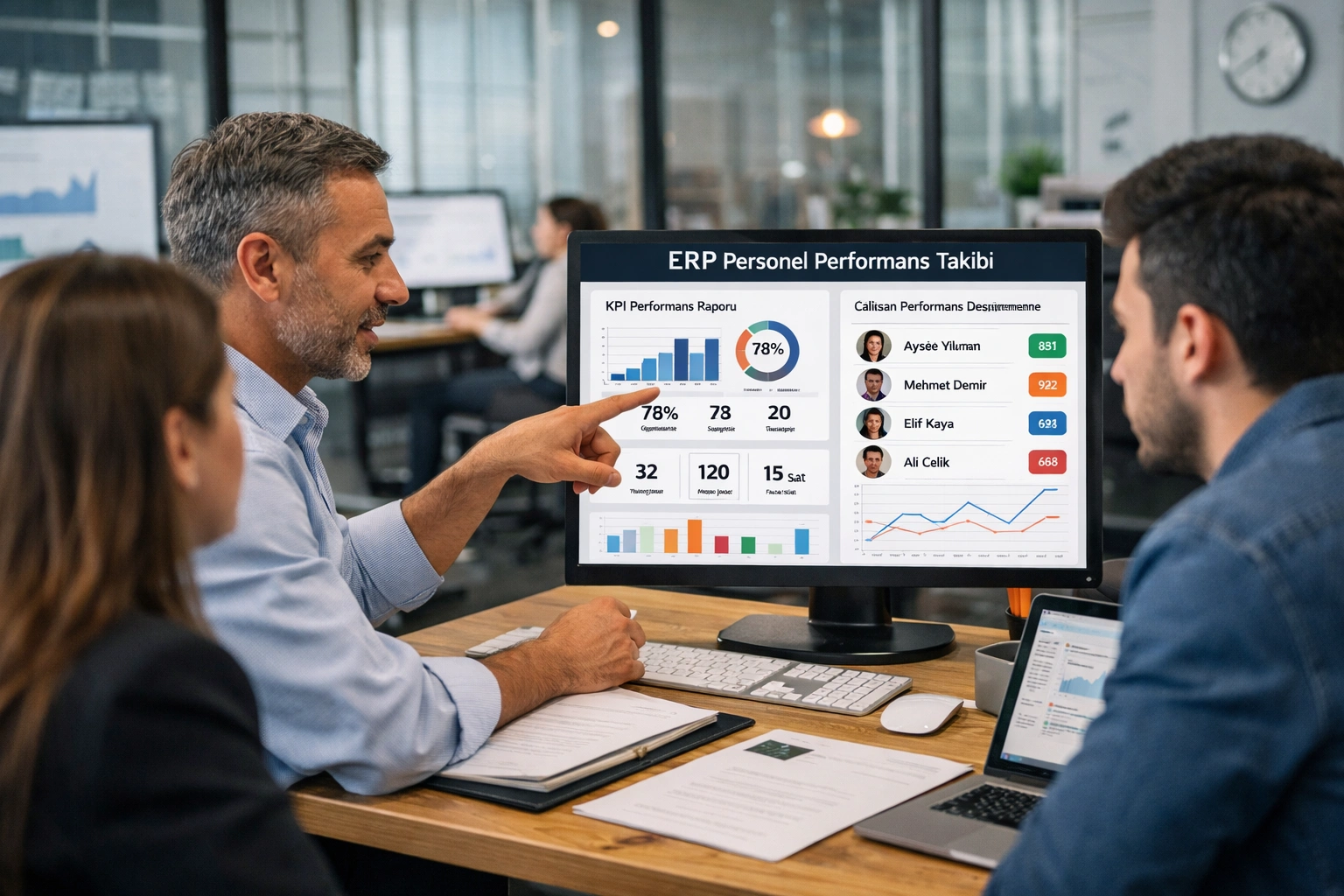
One of the strongest aspects of employee performance tracking with an ERP system is its reporting infrastructure. Department-based averages, target achievement rates, and changes over time can be viewed through management panels.
These analyses generate data not only for individual performance but also for organizational decision-making. They clearly reveal which departments are deviating from targets, which positions have workload imbalances, or which teams are achieving increased productivity.
Entranet ERP solutions provide managers with real-time monitoring by making performance data traceable through dashboard logic. This transforms performance evaluation from a yearly task into a regularly tracked process.
The Contribution of ERP-Based Performance Management to the Organization
In companies that implement employee performance management with ERP systems, the evaluation process becomes more transparent. Employees know what objective they are being evaluated against, and managers can show what data they based their decisions on.
This structure strengthens the element of trust in human resources processes. It also ensures a more consistent operation of the bonus and reward system. Considering that performance that cannot be measured cannot be managed, ERP infrastructure brings performance tracking to a corporate level.
Conclusion
Tracking employee performance with an ERP system creates a data-driven management culture within the company. Performance measurement using KPIs, integration of leave and attendance data, and regular reporting make the performance evaluation process more systematic.
Entranet ERP solutions integrate Human Resources and Operations modules, making performance management a natural part of the company's workflow. Thus, performance is treated not just as something measured, but as a process that is analyzed and improved upon.