























Human resources management is a complex structure that parallels the growth rate of companies. As the number of employees increases, managing issues such as personnel information, leave processes, performance evaluations, and recruitment manually leads to both time loss and a serious risk of errors. Today, while human resources departments are expected to play not only an operational but also a strategic role, managing these processes with decentralized systems is unsustainable. This is where ERP systems become the fundamental building block of human resources management.
In Human Resources Management, ERP is an enterprise solution that enables the integrated and secure management of all employee processes through a single platform. Thanks to ERP infrastructure, human resources departments cease to be merely record-keeping units and acquire a strategic role that feeds into the company's decision-making mechanism.
What does ERP mean in Human Resources Management?
ERP (Enterprise Resource Planning) systems are software solutions that bring together all the core processes of a business under a common data structure. From a human resources perspective, ERP means that all employee information is kept in a central system and managed in an integrated manner with other business processes.
Many functions, such as personnel records, leave requests, attendance control, performance evaluations, and recruitment processes, work together under an ERP system. This structure eliminates the need for repeated data entry while ensuring all departments have access to the same up-to-date information. As a result, human resources management becomes more transparent, traceable, and reportable.
How do ERP systems transform human resources processes?
One of the most common problems in traditional human resources management is the fragmentation of processes. Sending leave requests via email, tracking attendance in different files, or conducting performance evaluations manually all create a significant operational burden for HR teams.
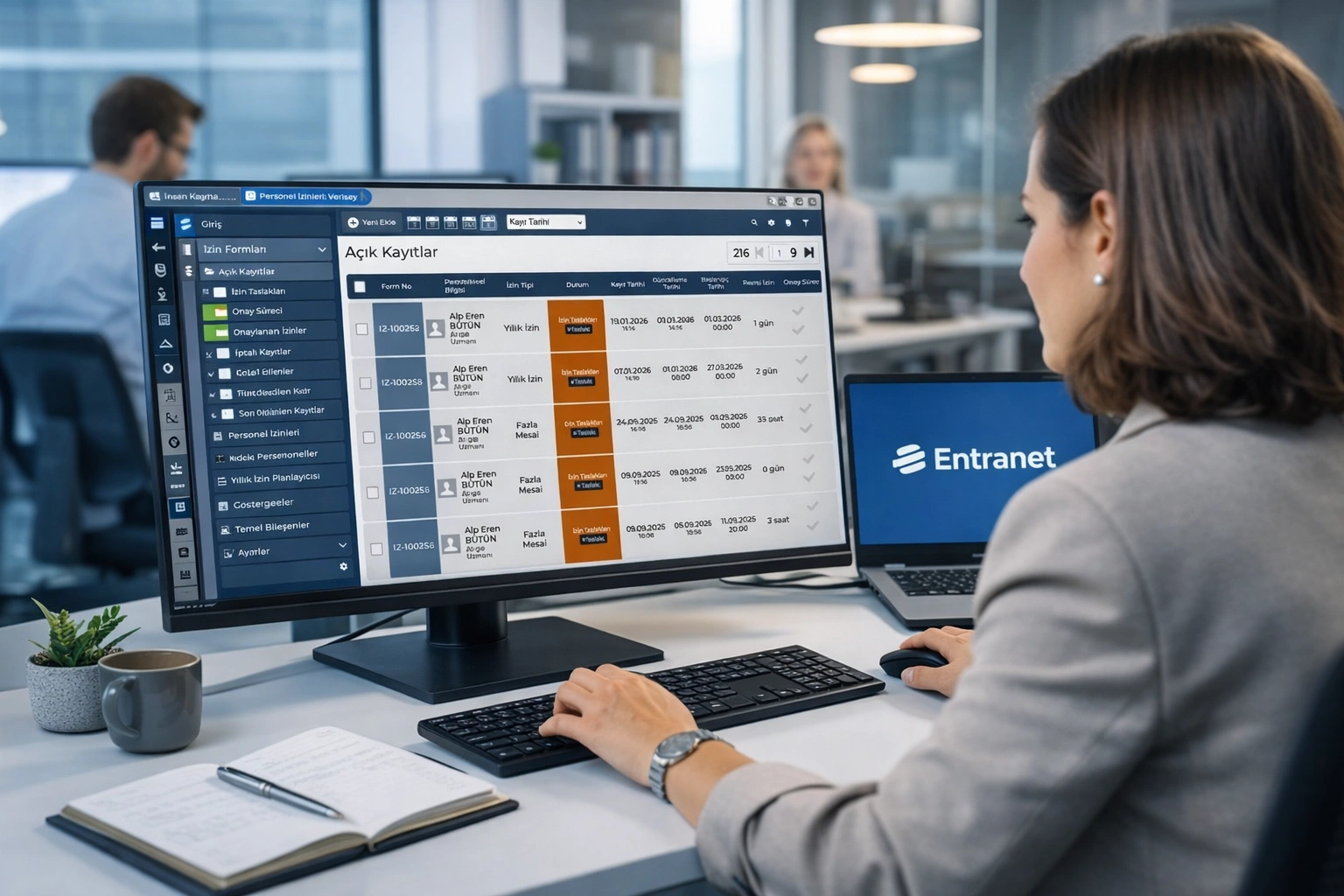
ERP systems eliminate this fragmentation, making it possible to manage all processes from a single center. For example , Entranet Cloud Suite ERP Human Resources solutions offer a holistic structure for many processes, from leave management and attendance control to performance evaluations and expense requests. Employees submit their requests through the system, while managers can track the approval processes in real time. All these processes are automatically recorded and made reportable.
This transformation not only speeds up the process but also increases the accuracy and reliability of human resources data.
What are Entranet Human Resources Solutions?
Entranet's Human Resources solution offers a comprehensive modular structure that goes beyond traditional HR management. It's not just a personal information database, but an integrated system that addresses the entire HR lifecycle.
Here are the core human resources functions offered by Entranet:
- Leave Management: Enables employees to initiate leave management processes via web or mobile by defining specific leave types.
- Employee Attendance Control: Automatically or manually records entry and exit times and generates attendance reports.
- Employee Performance Management: Measures employee performance and systematizes career planning and evaluation processes.
- Recruitment Processes: By publishing job applications on your website, you can manage incoming CVs directly within your ERP system.
- Expense Requests: This module allows you to quickly enter and approve employee expense requests, and automates the process of transferring approved requests to accounting.
- Personnel Inventory and Information Database: Provides comprehensive records of employees' assigned items such as computers and phones, as well as their personal and personnel information.
- Internal Communication: Strengthens the organizational communication network through tools such as messaging, announcement sharing, and forums among employees.
All of these functions are integrated into the ERP's central data model; thus, updates made in any module are instantly reflected in other related processes. This protects data integrity and ensures that all teams have access to the same real-time information.
Advantages of Managing Human Resources with ERP for Businesses
ERP-supported human resources management not only provides businesses with operational ease but also enables healthier decision-making. Thanks to the centralized data structure, managers can instantly access critical information such as employee numbers, leave usage, performance trends, and department-based productivity.
This data enables more informed development of human resources strategies. Training plans, staffing needs, and organizational development steps are now based on real data, not guesswork. Especially in growing and scaling companies, ERP is one of the most effective ways to keep human resources management under control.
Why Entranet Cloud Suite ERP for Human Resources Management?
The complexity experienced in human resources processes is often seen as a natural consequence of growth. However, with the right ERP infrastructure, this complexity can be managed and even transformed into a competitive advantage. Entranet Cloud Suite ERP makes this transformation possible by integrating human resources processes with all other business processes of the company.
Entranet Cloud Suite ERP, with its cloud-based architecture offering access from anywhere, makes human resources management more flexible, secure, and efficient. Bringing HR processes together on a single platform improves employee experience and strengthens managerial control.
If you want to take digitalization in human resources management a step further and manage your processes with an integrated structure, Entranet Cloud Suite ERP Human Resources solutions offer a strong starting point on this journey.