
























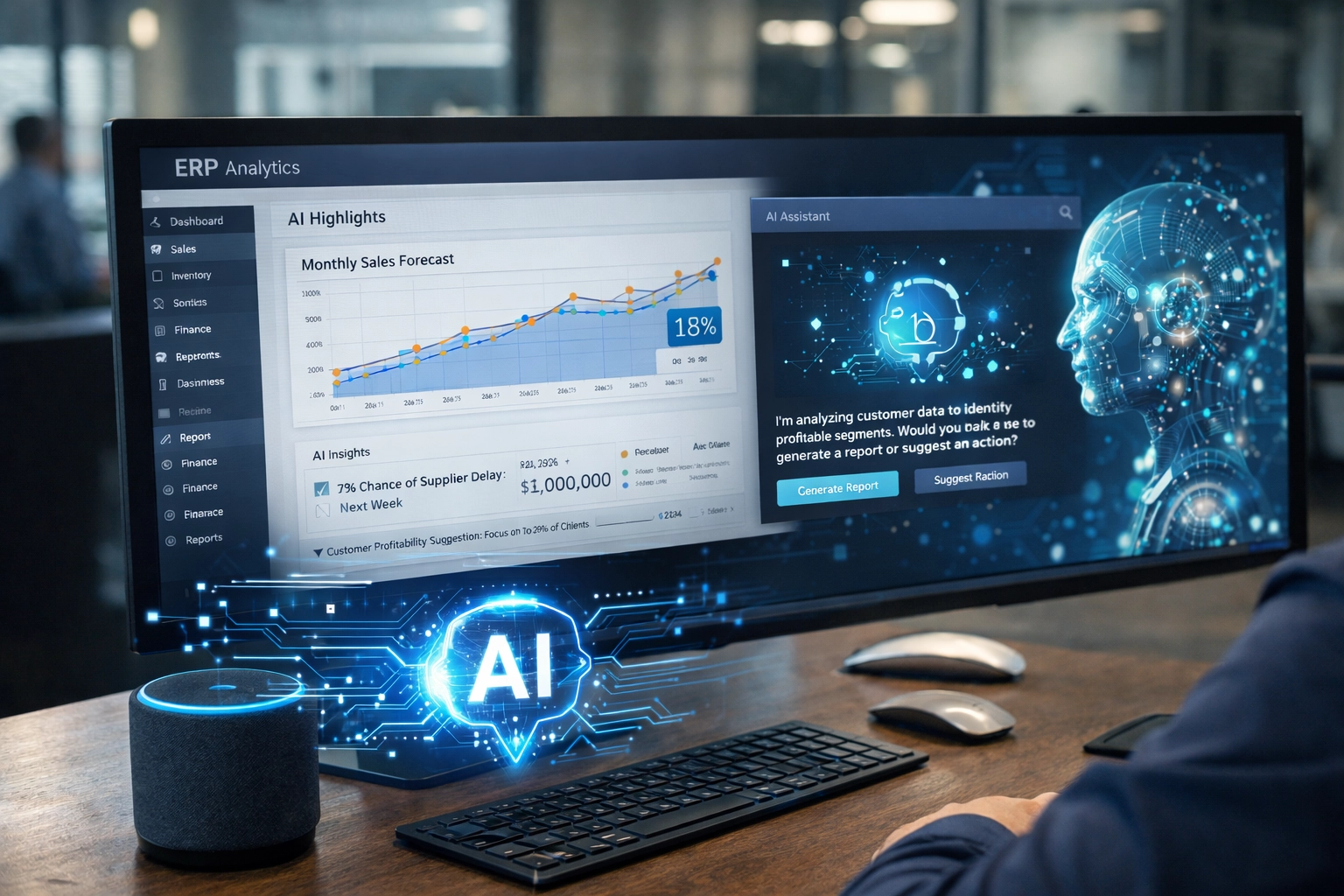
For a long time, ERP systems were positioned as the operational memory of businesses. Financial transactions, inventory changes, purchasing processes, and sales data were collected in a centralized structure. However, the centralization of data did not increase the speed of decision-making to the same extent. On the contrary, as the volume of data grew, ERP screens became more complex, and the system transformed into a tool that only certain users could effectively utilize.
Although many businesses today have ERP systems, strategic decisions are still shaped by manual reports, exported spreadsheets, and personal interpretations. While ERP is at the heart of the organization, it fails to become central to the decision-making process. This is precisely where artificial intelligence integration comes into play.
Decision-Making Problems in ERP Systems
Classic ERP architectures were built on transaction accuracy and data integrity. User experience and speed of information access were considered secondary priorities. Reporting mechanisms mostly relied on predefined queries and static filters. The user had to know which information was stored where and which report could be used to access it.
This approach transforms ERP from an information production system into a record archive. Summaries, trends, and risk indicators needed at the management level fail to become natural outputs of the system. ERP provides data but not context.
The Real Role of Artificial Intelligence in ERP
Artificial intelligence integrated into ERP systems aims for much more than just automated process execution. The real transformation lies in how data is interpreted. AI can establish relationships between scattered datasets within the ERP, analyze changes over time, and translate user intent into technical queries.
At this point, ERP is moving away from being a passive system. It's evolving into a structure that tries to understand what the user wants to see and evaluates data within a business context. This change opens the way for interaction using natural language.
The Rise of Natural Language Interaction in AI and ERP
Natural language interaction represents a fundamental shift in mindset in ERP adoption. Instead of a system that demands technical knowledge from the user, it creates a structure that can understand business questions. Instead of navigating through ERP screens, users can directly request analysis.
In this model, the user doesn't generate reports. They ask questions.
The system doesn't just present data. It interprets it.
The value creation capacity of ERP systems is significantly increased through this form of interaction. Access to information is shortened. Reporting processes are simplified. Management decisions are based on analytical rather than intuitive principles.
The Infrastructure of Natural Language-Based ERP Analytics
This capability isn't just a simple interface layer. It requires a rethinking of the ERP data model. The analytics layer is separated from the transaction layer. Business rules are clearly defined. Data is made queryable and relational.
Natural language queries are analyzed not only by word matching, but also by considering role, context, and time. The same question can be approached with different priorities by a finance manager and an operations manager. ERP is moving away from being a system that produces a single type of output.
Functional Simplification in User Experience
One of the biggest obstacles to ERP adoption is the learning curve. Complex screens, lengthy training processes, and reliance on expert users make it difficult to deploy the system across the entire organization. Natural language interaction directly eliminates these obstacles.
Instead of learning about ERP, the user defines their business problem. The system then generates the necessary analysis. This approach ensures that ERP ceases to be merely a tool for the finance or IT department. The system becomes usable with equal effectiveness by management, operations, and sales teams.
Repositioning ERP at the Management Level
For senior management, the value of an ERP system is measured not by detailed transaction lists, but by its contribution to decision-making quality. AI-powered natural language analytics provide managers with direct insights. Performance dips, risk areas, and profitability trends become visible without the need for manual reporting processes.
At this level, ERP ceases to be merely an operational tool. It transforms into a part of the strategic decision-making infrastructure.
Corporate Maturity and Artificial Intelligence Alignment
AI-powered ERP solutions do not produce the same results in every organization. In structures with low data quality, undefined processes, and weak integrations, AI remains only a superficial feature. Positioning the ERP as a central system is a fundamental requirement for this transformation.
As data consistency, process discipline, and integration levels increase, the outputs produced by artificial intelligence gain meaning. The value of ERP increases exponentially, not linearly.
The Entranet Perspective in the Evolution of ERP
The future of ERP is shaped less by adding more modules and more by simplifying interaction with the system. Integrated business processes, centralized data structures, and user-centric system architectures are among the key components of this transformation.
For up-to-date approaches and industry-specific content related to ERP and business processes.
Relevant resources can be reviewed via https://www.entranet.com .
New Standard in Interacting with ERP
ERP systems are evolving from structures that wait for commands to systems that understand intentions. Solutions that analyze rather than generate reports, and that reveal trends rather than simply displaying history, are coming to the forefront. Natural language interaction is at the heart of this transformation.
ERP is no longer considered just software, but a decision-making infrastructure.
Conclusion
The interaction of artificial intelligence and natural language in ERP is not a temporary technological trend, but an indicator of structural transformation. As data volumes grow, this transformation becomes inevitable. The true value of an ERP is measured not by the amount of data it possesses, but by the insights it generates.
In today's competitive environment, companies that make a difference are those that not only use ERP but also think in terms of it.