





















What are the differences between CRM and ERP?
Select another country or region to see products specific to your location.
TR

What are the differences between CRM and ERP?

For today's businesses, the real value lies in being able to use CRM and ERP together in an intranet-based, integrated, and decision-making-focused structure. While clarifying the differences between CRM and ERP, we discuss why the intranet approach offers a strategic solution for companies seeking to make the right software decision.

What are the differences between CRM and ERP?

Digitalization is no longer just a technological investment; it has become a strategic choice that directly determines how companies are managed and grow. For organizations aiming for growth, managing customer relationships effectively is just as critical as keeping internal processes under control. At this point, CRM and ERP systems are becoming a priority for almost every business. However, the real question isn't "CRM or ERP?", but rather how these two approaches are positioned within the company and how they contribute to decision-making processes.

Many companies invest in software by treating CRM and ERP separately. As a result, sales teams work from one system, and finance and operations teams from another. Data remains scattered, managers struggle to see the whole picture, and the software fails to deliver the expected value. However, what is needed in today's business world is an intranet-based, decision-maker-centric structure that unifies customer-side and operational processes under a single perspective.

This article will address the differences between CRM and ERP not only in terms of definitions but also through the lens of real business needs; we will examine which approach is sufficient in which situation and why integrated solutions have become inevitable. We will also clearly demonstrate how the Entranet approach combines CRM and ERP under a single enterprise experience and why it offers a powerful path for companies seeking to make the right software decision.

The Right Way to Choose the Best Software

Digitalization is no longer a choice for companies, but a strategic necessity that directly creates a competitive advantage. In today's business world, where customer expectations are rapidly changing and operational processes are becoming increasingly complex, companies that fail to establish the right software infrastructure face serious risks in terms of growth, productivity, and sustainability. At this point, one of the most frequently asked questions for businesses is: CRM or ERP? Or both?

Although CRM and ERP concepts are often mentioned together, they are actually systems that solve very different business problems and offer different perspectives. Choosing the wrong software can result in high costs, poor user adoption, and a failure to achieve the expected benefits. The right choice, on the other hand, secures not only the present but also the company's future for the next few years.

This article will explain what CRM and ERP systems are, the differences between them, and which one should be preferred in which situation. It will also clearly demonstrate why modern businesses should turn to integrated, intranet-based, and decision-maker-focused solutions .


What is CRM and Why is it Critical for Businesses?

What are the differences between CRM and ERP? - 20.webp

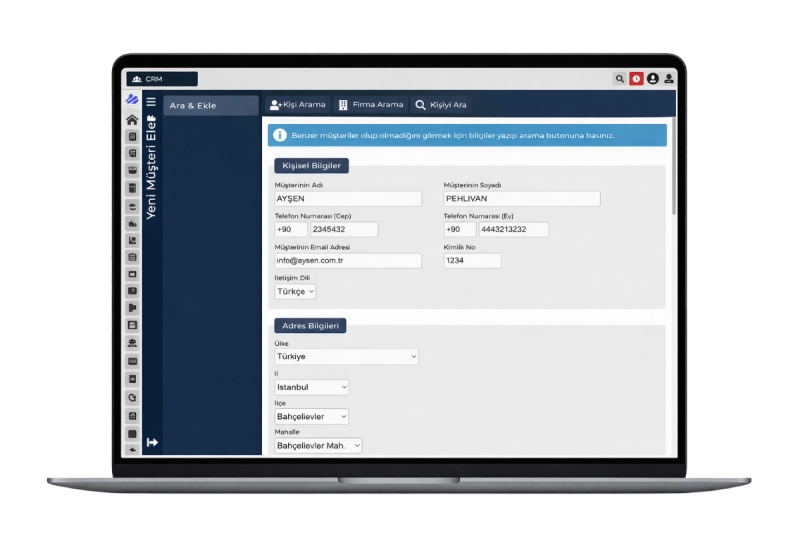
CRM, or Customer Relationship Management, is a system that allows a business to manage all its interactions with its customers from a single center. However, CRM is not just a "customer registration program." A properly designed CRM infrastructure is a strategic decision-making support mechanism that feeds the entire organization, from sales and marketing to customer service and senior management.

The core focus of CRM is the customer. The entire journey of a potential customer, from initial contact to sales, after-sales support, and the likelihood of repeat purchases, is transformed into meaningful data within CRM. This data allows sales teams to manage opportunities more effectively, marketing teams to create targeted campaigns, and managers to make decisions based on real data.

However, there is a critical point here. When used in isolation, CRM often remains a “department-based” solution. While sales or marketing teams benefit from CRM, other departments may not have full access to this data. This is where intranet-based approaches come into play, transforming CRM from merely a sales tool into a corporate intelligence.


What is ERP and what problems does it solve?

ERP, or Enterprise Resource Planning, is a general term for systems that manage a company's internal operations end-to-end. Critical processes such as finance, accounting, human resources, production, inventory, purchasing, and logistics are integrated under an ERP system. The main purpose of ERP is to increase efficiency and minimize errors by consolidating scattered business processes under a single data source.

ERP systems are indispensable, especially for growing and increasingly complex organizations. They eliminate the loss of control caused by manual processes, Excel spreadsheets, and fragmented systems. However, it's important to remember that ERP systems, by their nature, focus more on internal operations. ERP looks more at the process than the customer. This brings with it both the strengths and limitations of ERP.

Many companies realize that even after investing in ERP, they still lack sufficient visibility on the customer side. This is because the ERP is not designed to analyze customer behavior, expectations, and communication history in detail. This situation brings the need for CRM back to the forefront.


Where does the fundamental difference between CRM and ERP begin?

What are the differences between CRM and ERP? - 23.webp

The difference between CRM and ERP begins with perspective before technical details. CRM is outward-looking. It focuses on the customer, the market, and revenue. ERP is inward-looking. It focuses on controlling processes, resources, and costs.

CRM seeks answers to questions such as, "Who is the customer, what do they want, and how do they buy?"; while ERP answers questions such as, "How do we produce this order, how do we invoice it, and how do we deliver it?". One aims to grow revenue, the other to maintain profitability.

This difference is also reflected in how the software is used. CRM is more flexible, more user-friendly, and adaptable. ERP, on the other hand, presents a more disciplined, rule-based, and generally more complex structure. Therefore, ERP projects take longer, while CRM projects yield results more quickly.

However, for modern businesses, considering these two approaches separately is no longer sufficient. In today's competitive environment, the real differentiator is being able to combine CRM and ERP under a single corporate experience .


Why is neither just CRM nor just ERP sufficient anymore?

Today's decision-makers don't just want to see reports. They demand meaningful insights, instant visibility, and cross-departmental transparency. The financial implications, inventory status, and operational impact of a sales team's proposal must be immediately apparent. Similarly, it must be clear how a delay in the ERP system will affect customer satisfaction.

When CRM and ERP are used separately, this integration cannot be achieved. Data remains disconnected between systems, manual transfers increase, and errors become inevitable. Most importantly, management struggles to see the big picture.

This is where intranet-based, integrated solutions come into play. Because an intranet enables not only the technical integration but also the organizational integration of CRM and ERP.


Why an Intranet-Based Approach is a Game Changer

An intranet is like a company's digital hub. It's the main platform where employees conduct their daily tasks, access information, and track processes. Integrating CRM and ERP systems with the intranet transforms these systems from background software into active participants in decision-making processes.

In an intranet-based structure, CRM data doesn't remain solely on the sales team's screen. Managers, project teams, or the finance department can access this data within their authorized scope. Similarly, ERP data becomes a common language not just for accounting, but for the entire organization.

This approach fosters a culture within the company where data is shared, not just stored. Decisions are based on shared and up-to-date data, not personal intuition. This is where the Entranet approach's fundamental difference lies.


What is the right way to choose the best software?

Choosing the right software is much more than just asking "CRM or ERP?". The real question is: Which digital infrastructure will carry your company's present and future together?

If your goal is simply to track sales, a simple CRM might suffice. If you only need accounting and inventory control, a classic ERP system could work. However, for companies aiming for sustainable growth, wanting to avoid disconnect between departments, and seeking to increase decision-making speed, this approach is insufficient.

The right approach is to create a system that connects CRM and ERP, extends throughout the entire organization via an intranet, and centers the decision-maker. This is where intranet solutions come in. Because an intranet treats CRM and ERP not as separate modules, but as parts of a single corporate experience.


How do CRM and ERP generate value with an intranet approach?

In an intranet ecosystem, CRM doesn't just collect customer data; it interprets it and makes it accessible to the entire organization. Sales performance, customer satisfaction, opportunities, and risks become monitorable from a single central location. ERP, on the other hand, connects this customer data with operational reality. The process of ordering, producing, shipping, and invoicing is tracked transparently.

This structure provides managers with answers not only to the question "what happened," but also to "why did it happen" and "what should we do." This is precisely where the decision-maker-focused sales approach becomes meaningful.


Conclusion: The Right Software Decision is a Management Decision, Not a Technology Decision.

Understanding the differences between CRM and ERP is important, but the real difference lies in how you design these systems. Fragmented solutions may seem effective in the short term, but they create chaos in the long run. Integrated, intranet-based, and scalable solutions, on the other hand, will take the company into the future.

The best software isn't the one with the most features; it's the one that accelerates your company's decision-making processes, unites teams towards common goals, and makes growth sustainable. The Entranet approach combines CRM and ERP with this perspective, offering a solution that meets not only today's needs but also tomorrow's.

If you want to view your software investment not as a cost, but as a strategic leverage, you should make your choices based not just on modules, but on your vision .